Where Should You Put a Bird Feeder?
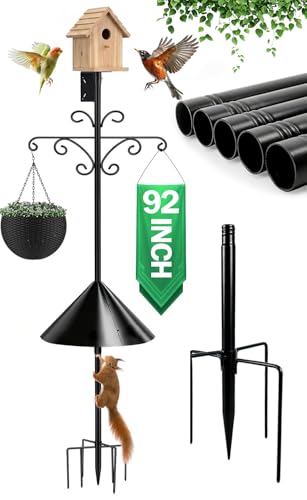
The best bird feeder placement balances three distances at once: height off the ground, distance from windows, and distance from squirrel launch points like railings, roofs, and tree limbs. A multi-hook station such as the YINGYM 6-Hook Feeding Station makes it easy to test a few spots and feeder types before you commit to a permanent pole location.

Where should a bird feeder go in the yard?
Put feeders 10 to 12 feet from a shrub or tree line. That gap gives songbirds a quick escape route from cover without letting a hiding cat get close enough to ambush the feeder. Avoid tucking a feeder directly against dense shrubs at ground level, since that is exactly where a cat waits.
Open lawn far from any cover works against you too. Birds feel exposed and visit less. A spot with a clear flight path to nearby brush or a tree, but not right against it, gets the most consistent traffic.
Feeder type changes the ideal spot slightly. A tube feeder or hopper feeder hung from a pole or branch draws the widest range of species and tolerates almost any of the yard positions above. A platform feeder sits lower and closer to the ground, which suits juncos, doves, and sparrows that rarely use a hanging feeder, but a low platform is also the easiest target for a cat, so keep it further from dense cover than a hanging feeder at 5 to 6 feet would need to be.
A feeding station with several feeder types on one pole, such as a full beginner feeding station kit, lets you place one hub in the best overall spot rather than compromising across several scattered locations in the yard.
How far should a bird feeder be from windows?
Follow the American Bird Conservancy guidance: keep feeders within 3 feet of the glass or beyond 30 feet. Feeders in that middle zone are the most dangerous, because birds startle from the feeder and build enough speed to hit the glass hard. Inside 3 feet, a bird cannot gain lethal speed before it recognizes the glass. Beyond 30 feet, the window and its reflections read as a distant, unthreatening background instead of open sky.
If you already have a feeder in that middle zone and cannot move it, add window decals or tape to break up the reflection instead.
What is the best bird feeder height?
Most hanging feeders do well at 5 to 6 feet off the ground. That height is above where most dogs and curious kids can reach, low enough to fill without a ladder, and matches the natural feeding height for cardinals, chickadees, and finches. Ground-feeding species like juncos and mourning doves still need a low platform or spilled seed underneath, since they rarely use a hanging feeder at any height.
Height also affects how easy a feeder is to keep an eye on from the house. A feeder mounted too high to see clearly from a window loses some of its appeal even if it is otherwise correctly placed, so weigh viewing height alongside squirrel and pest considerations rather than optimizing for squirrels alone. A feeder that sits a foot or two lower than ideal but is easy to watch daily often gets checked, refilled, and cleaned more consistently than one placed for theoretical perfection at the back of the yard.
How do you place a feeder to avoid squirrels?
Squirrels can jump about 8 to 10 feet horizontally and 4 to 5 feet straight up from a running start. That means a pole feeder needs to sit at least 10 feet from any deck rail, fence, roofline, or overhanging branch a squirrel could launch from. A baffle only works if the squirrel cannot simply jump past it, so distance comes first and hardware comes second.
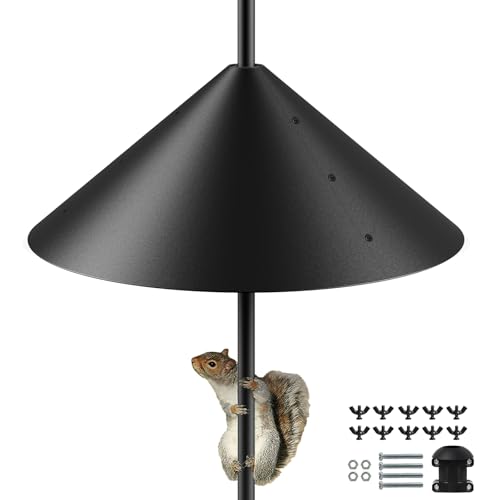
Once the pole is far enough from launch points, add a baffle with its bottom edge 4 to 5 feet up the pole, such as the KITVONA 19 Inch Metal Squirrel Baffle. A full station like the YINGYM 6-Hook Feeding Station already builds this baffle height into the design. For the full mechanics of squirrel-resistant feeders, see the squirrel-proofing guide.
Gear for this job
Prices move constantly; the button shows the current figure.

Should a feeder get sun or shade?
Partial shade is the safer default. Full afternoon sun heats seed and speeds up spoilage, and it can warp plastic ports over time. Full shade all day keeps a feeder damp longer after rain, which invites mold. A spot with morning sun and afternoon shade, or dappled light under a tree canopy, holds up best in most climates.
Wind exposure matters alongside sun and shade, especially through winter. A feeder in an exposed, wind-scoured spot burns through more seed relative to bird visits, since some seed simply blows off open tray-style feeders, and birds themselves spend more energy staying warm in a windy feeding spot than a sheltered one. A location with a windbreak nearby, like the same tree line already recommended for cover, does double duty against both weather and cats.
Deck, patio, or ground pole: what mounts work best?
A yard with open ground gives you the most flexibility, since a ground pole can sit the full 10 feet from any jump point. Renters and patio setups without that option can use a deck-mounted arm like the Kingsyard Heavy Duty Deck Hook, but understand that a deck feeder is almost always within squirrel jumping range of the railing itself, so treat squirrel-proof feeder hardware as mandatory rather than optional in that setup.
How many feeders and how far apart should they be?
Spacing multiple feeders 8 to 10 feet apart spreads out birds, reduces crowding at any single feeding port, and limits how far droppings and old hulls concentrate in one spot, which lowers disease risk. Clustering feeders shoulder to shoulder looks tidy but works against the birds using them.
| Placement factor | Target distance |
|---|---|
| From a window | Within 3 ft, or beyond 30 ft |
| From a squirrel launch point | 10 ft or more |
| Height off the ground | 5 to 6 ft |
| From dense shrub cover | 10 to 12 ft |
| Between multiple feeders | 8 to 10 ft |
| Baffle bottom edge up the pole | 4 to 5 ft |
What you need
Prices move constantly; the button shows the current figure.

Get the printable checklist
One page with every item, the placement distances and the cleaning schedule. We send it once. No sales sequence.
Used only to send the checklist.Frequently asked questions
How far should a bird feeder be from the house?
There is no fixed minimum distance from the house itself, only from windows and squirrel launch points. A feeder mounted 3 feet from a window is fine, and one 30 feet away is fine, but the middle zone between those two distances raises collision risk. Keep any pole feeder 10 feet from the roofline or a deck rail so squirrels cannot jump onto it.
Does a bird feeder need to be in the sun or shade?
Partial shade works best for most climates. Full sun all day heats and dries out seed faster and can degrade plastic feeder parts, while full shade keeps a feeder damp longer after rain, which encourages mold. Morning sun with afternoon shade, or a spot under open tree canopy, keeps seed fresher and the feeder itself in better condition.
Can a bird feeder be too close to a window?
A feeder can be too close only in the sense of the middle-distance zone: past 3 feet but short of 30 feet is the riskiest range for window strikes, according to American Bird Conservancy guidance. Right against the glass, within 3 feet, birds cannot build enough speed to injure themselves before recognizing the surface, so very close is actually safer than a mid-range distance.
What height should a hanging feeder be?
Five to 6 feet off the ground suits most hanging feeders and matches natural feeding height for cardinals, chickadees, finches, and nuthatches. That height also keeps the feeder above where most dogs can reach while still being fillable without a ladder. Ground-feeding species like juncos and mourning doves need a separate low platform regardless of hanging feeder height.
How do I stop squirrels from reaching my feeder?
Move the pole at least 10 feet from any deck rail, fence, roofline, or branch a squirrel could jump from, since squirrels cover 8 to 10 feet horizontally in a single leap. Then add a baffle with its bottom edge 4 to 5 feet up the pole. Distance solves most of the problem on its own; the baffle catches squirrels that still try from the ground.